Showing posts with label Unit IV. Show all posts

Wednesday, July 23, 2014

Unit IV: The One-Party State: Mexico & PRI (4/1)

Corresponding text found on p226-262 of Concise History of Mexico.

Partido Nacional Revolutionario formed by Calles as way to organize influential leaders for elections
Consistent re-election of regional strongmen under PNR banner creates de facto one party state
Becomes bureaucracy that held the keys to power in Mexican politics
Entrenched bureaucratic and powerful government, supported by strong military and labor unions

Despite attempts at modernizing economy, in 1930, 69% of Mexicans still worked in agriculture
Export economy diversified enough to withstand Great Depression better than most of Latin America
1934 - Lazaro Cardenas elected President; more independent of Calles; more reform minded
Lazaro Cardenas
1937 - fully nationalized the railways
numerous agricultural reforms; expanded redistribution of haciendas to ejidos
1938 - petroleum industry nationalized (seen as nationalist move, not socialist move); 1st state to nationalize petroleum industry; formation of PEMEX
Crowds gather to support nationalization of oil industry

Internal discontent within party against Cardenas
1938 - Cardenas reorganizes PNR into 4 'sectors'; new Partido de la Revolucion Mexicana
                  - Organized labor
                  - Peasant union
                  - Army
                  - Popular sector
Reforms strengthen power on central government
Continuing struggles between state and Catholic Church; only 33 priests left in state of Michoacan by 1932
1937 - UNS, a Catholic nationalist movement formed; base of support in center-north-west states; core was made up of rural bourgeoisie and lower-middle class professionals
Union Nacional Sinarquista
UNS opposed Marxism but supported nationalization of oil industry; opposed agrarian collectivism; opposed state education reforms
Formed significant opposition to one-party rule; denounced PNR as Porfirian
Loses support due to govt reaction, including govt modification of anti-clerical positions

Demand for oil during WWII, combined with formation of PEMEX, boon to Mexican economy
Mexico moves from predominantly rural population in 1930 to 50-50 by 1960; life expectancy increased substantially and illiteracy decreased dramatically
Divided left and appeased Catholic population allow PNR candidate Manuel Avila Camacho easy Presidential victory in 1940
Reapproachment with business class

1946 - renaming of party - Partido Revolutionario Institucional (PRI); Migeul Aleman elected President
Maintains strong base of support among peasants and labor; influence held with business class elite
Growth of economic nationalism and government services
Pro-business climate so long as it remained within scope of national interest
Manufacturing sector, centered in north, still predominantly owned by foreign interest; significant portion of Mexican economy

Disillusionment with PRI leads to formation of opposition party PAN; limited success
Problems of modernization present as well; by 1960, Mexico City had population of 6 million
Modernizing Mexico City
1968 - Mexico City hosts Summer Olympics; student protests against govt abuse of civil liberties
Government crackdown on 'leftist' opposition; October 'massacre'

Student protesters - Mexico City 1968
Marks division between PRI and intellectual middle class; threat to one-party rule

Unit IV: Cold War Battles in Guatemala, the Dominican Republic , and Beyond (4/2)

This is an excellent 10 minute synopsis of US actions in Guatemala in 1954 and of their effects on Latin America and the Caribbean. 


Corresponding text is found on p256-263 of Brief History of the Caribbean.

Government barely functioned in the Dominican Republic since independence
1915 - US Pres Wilson demands DR allow US officials to control govt finances, train police, replace army
Dominican govt refuses
1916 - Marines begin occupation of DR; build roads, schools, improve public sanitation, replace army with new National Guard
1924 - US troops leave

1927 - Rafael L Trujillo takes command of National Guard; becomes DR army by '28
1930 - with army support, Trujillo gains presidency; given extraordinary powers to deal with crises of Depression and hurricane; retains these powers throughout rule (renames Santo Domingo - Ciudad Trujillo)
Rafael Trujillo
WWII proves beneficial to DR economy
   - export profits boom
   - foreign debt disappeared
   - currency stabilized
   - middle class grows
   - govt investment expands in roads, airports, tourism, rail, education (illiteracy declines)

Massive corruption; use of torture and murder against political opponents; no free elections

Late 50's - sugar prices collapse; tourism declines
1960 - Trujillo tried to have President of Venezuela assassinated; condemned by OAS and US

May 1961 - Trujillo assassinated by DR army officers (CIA support?)
Joaquin Balaguer assumes interim presidency

Dec 1962 - Juan Bosch elected president
   - land redistribution
   - new Constitution weakens role of Catholic Church
   - threatens to weaken army
   - tolerated Communist Party
Juan Bosch
 Sept 1963 - Bosch arrested by military; exiled to Puerto Rico

Military govt promises to organize new elections
Military and population divide into supporters of Bosch and supporters of Balaguer
In exile, Bosch writes scathing criticism of ruling class of DR; calls for sweeping structural changes; earns support of Communists
April 1965 - Bosch-sympathetic army officers seize parts of Santo Domingo

23,000 US Marines occupy DR
June 1966 - new elections in DR; Balaguer wins presidency
Joaquin Balaguer
New Constitution which establishes more central, top-down system of government; very powerful President
Presidency from Balaguer to Bosch and back from 60s through 1990s

Unit IV: Changes in the British Realm: Independence, Federation, and Chagaraumas (4/3)

Corresponding text found on p319-323 of Brief History of the Caribbean.

Post WWII, Britain began to free colonies in Asia, Africa, Middle East; idea of European Community vs British Global Empire
British Empire around 1945 seen in red

West Indies colonies seen as drain on British economy (unlike India)
West Indies colonies also seen too small and weak to survive independently; yes to more self-government

Steps from Crown Colonies to Self-Rule
  - grant universal adult suffrage (1944-Jamaica; 1946-Trinidad; 1951-53-remaining islands)
  - allow elected members of colonial assembly to take part in governance
  - allow certain elected members of assembly to direct a Ministry in government
  - when majority of Ministers come from elected assembly, then Executive Council becomes governing body
  - leader of majority party becomes chief minister in territory, taking over from colonial governor
            (happened in Jamaica by 1953; in Trinidad by 1959)
  - Fully self-governing colony becomes 'associated state' in British Commonwealth
             (not fully independent; British Colonial Office still runs foreign policy and defense forces)

The West Indies Federation: 1958-1962
The Islands of the West Indies Federation appear in red

 Idea had support from labor parties and influential non-governmental organizations
 Created of united entities: University of the West Indies; West Indies Cricket Board
 Formed of island states of Caribbean; British Guiana and British Honduras opted out
 Executive power in Federation held by British Governor-General
 Governor-General appointed the Council of State (federal cabinet)
 Legislative body was Federal House of Representatives; Federal HR chose Prime Minister


Lacked agreement on three important points (agreement to not address for 1st 5 years)
  - inter-island immigration
  - federal taxation
  - common import taxes

Sir Grantley Adams : 1st Prime Minister
Influential regional leaders such as Manley & Bustamante (Jamaica) and Williams (Trinidad) chose to focus on local governance issues rather than devote energy to developing Federation
Grantley Adams (left), Norman Manley (right), Dr Eric Williams (back-center)

Jamaica & Trinidad feared smaller islands would drain potential wealth in Federation
Jamaica & Trinidad also had disputes over influence in Federation (tax burden, representation, capital)

History of Chagauramas, Trinidad
  - part of bases-for-destroyers deal between US and Britain
  - becomes key element of push for self-rule in Trinidad; rallying point for Dr Eric Williams and PNM
  - Williams leads march from Port of Spain to Chagauramas in 1960 demanding return
  - complications of attempting to make it Federal Capital
US naval base at Chagauramas

Location of Chagauramas

Aerial view of Chagauramas

Role of internal politics in fate of Federation?

Sept 1961 - Jamaicans vote to withdraw from Federation

Federation quickly falls apart

1962 - Jamaica and Trinidad become independent nations in the British Commonwealth

1966 - Barbados became independent

Subsequent independence of most of British Caribbean possessions through 1970s and 80s

Unit IV: Cuba's Castro Revolution (4/4)

Fidel Castro
No course on Latin America & the Caribbean would be complete without an extensive look at the most significant figure in the 20th Century history of the region, Fidel Castro. To that end, in addition to text, class notes, and discussion, we will watch a documentary on Fidel.

Corresponding text found on p232-245 in Brief History of the Caribbean.

After being pardoned by Batista, Castro is exiled to Mexico; plots return
Dec 1956 - Castro, Che Guevara, and about 80 men; Granma; land under fire and escape into mountains
July 26 Movement survives and grows in Sierra Maestra; by 1958, Movement (and Castro) seen as leaders in opposition to Batista

Castro & rebels in the Sierra Maestra
Early 1958 - Castro starts using radio for propaganda; promises to restore Constitutional order and develop domestic economy
March 1958 - US stops arms shipments to Batista
Summer 1958 - Cuban Army fails in attempts to drive out and defeat rebels; Movement begins counteroffensive through Cuba
Jan 1 1959 - Batista flees Havana; Che Guevara's forces take city; Castro begins triumphant caravan to Havana
Castro enters Havana triumphantly

New government established, but all power rested with Fidel
Begins process of expropriation of property of established elites
May 1959 - Agrarian Reform Act; US govt protests
Propaganda war and Castro's 'charismatic authority'; Use of the Plaza de la Revolucion
Castro addresses a massive audience
As Castro centralizes power, compatriots protest growing influence of communists and personal ambition
1960 - quick dissolution of Cuba-US relations; subsequent quick engagement of Cuba-Soviet relations
Oct 1960 - Eisenhower issues trade embargo of Cuba
Jan 1961 - US-Cuba diplomatic relations severed
Mass exodus of Cuban elite between 1959-1962

April 1961- Bay of Pigs

Operation Mongoose


Castro continues to consolidate power and purge threats
Creates Committee for the Defense of the Revolution
Castro's rhetorical mission is to create a 'new man' with a 'revolutionary conscience'
Catholics could not join Communist Party or attend university
Government took control of all news outlets
Government regulated morality
1961 - Massive literacy campaign
March 1962 - food rationing begins

October 1962 - Cuban Missile Crisis


Sino-Soviet dynamics in Cuban development (pragmatism v idealism)
Che Guevara headed Ministry of Industry; runs economy
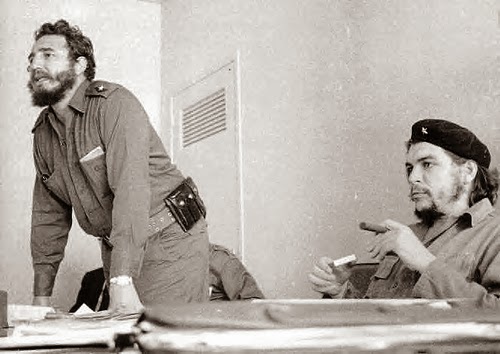
Castro & Guevara lead the planning of the Cuban economy
Failures and other problems leads Castro to reverse direction from rapid industrialization to agriculture by 63

1965 - Guevara resigns govt positions; travels to assist Communist rebels in Congo
1966 - Guevara travels to Bolivia to plant Communist revolution; killed 1967
Che Guevara

The famous Che Guevara

By 1968, Castro had gotten rid of almost all private ownership in Cuba

Despite massive efforts to reform Cuban economic system, economy struggles dramatically