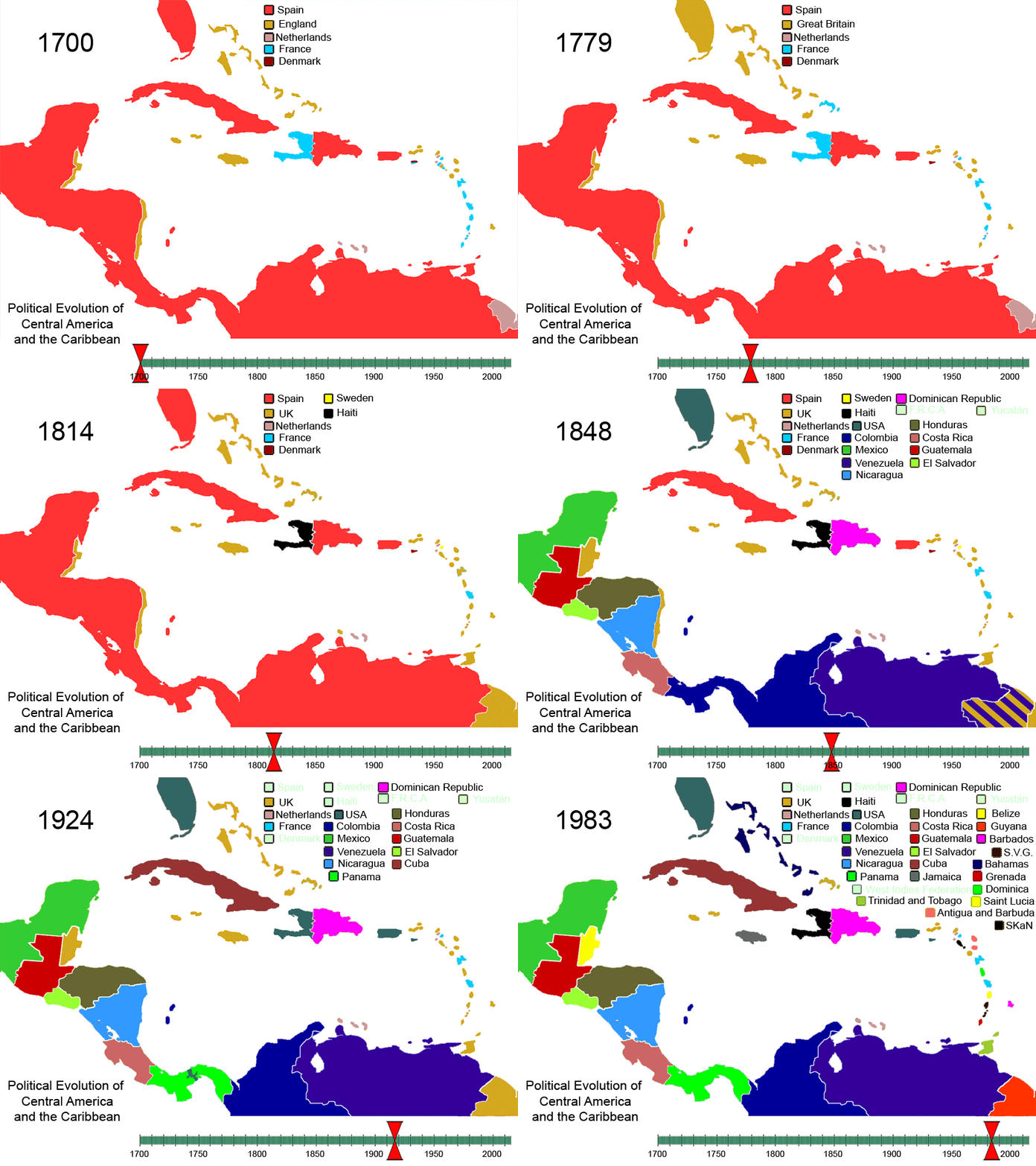
Moving south, let's look at Central America :
(Guatemala, Belize, Honduras, El Salvador, Nicaragua, Costa Rica, and Panama)
Central America: Physical Features
Central America: Political Divisions
Now we reach mainland South America:
South America: Physical Features
South America: Political Divisions
Finally, we move back north to view the Caribbean. The Caribbean is divided into two main subdivisions; the Greater Antilles and the Lesser Antilles. Within the Lesser Antilles division, there are two additional
sub-groupings; the Leeward Islands and the Windward Islands.
The Greater Antilles: Cuba, Jamaica, Hispaniola (Haiti & Dominican Republic), and Puerto Rico
The Lesser Antilles: Note the two sub-groupings of Leeward & Windward Islands
Leewards Islands: Virgin Islands (US & UK), Anguilla, St Martin, Antigua & Barbuda, St Kitts & Nevis,
Montserrat, Guadeloupe, Dominica
Windward Islands: Martinique, St Lucia, Barbados, St Vincent & the Grenadines,
Grenada, Trinidad & Tobago
The 3rd grouping are the Dutch Antilles also referred to colloquially as the ABC islands: Aruba, Bonaire, Curacao
Latin America & the Caribbean before the arrival of Columbus was populated by various native groups. Among them are:
The Maya (p30-45 of Concise History of Mexico)
The Aztec (p48-55 of Concise History of Mexico)
The Arawak (p15-16 of Brief History of the Caribbean)
The Carib (p17 of Brief History of the Caribbean)
Obviously there are many others, most notably the Maya, but this course does not go into any depth on any native culture.
Columbus voyages
The 4 voyages of Christopher Columbus
Cortes
Note the span of time between when Columbus "discovered" the Americas and Cortes conquered the Aztecs. What does that tell you about Spanish colonial society?
European colonialism
Excellent overview of the colonial legacy of the Europeans in Latin America by Jessica Barnes of
The Ohio State University
Piracy
Yes, pirates were real. However, our perceptions of their position in history has been distorted by Hollywood. (What else is new?)
Read on the reality of piracy in the Caribbean region
(p34-44 & p85-104 in Brief History of the Caribbean)
Cool documentary that uncovers Henry Morgan and his times.
History Channel's True Pirates of the Caribbean
Part of the legacy of pirates and buccaneers is how they assisted European powers in gaining advantage in the region and, subsequently, gaining territory. Check out this link for an illustration.
Part of the reason for the desire to own these new lands was that it was fertile ground for establishing plantations that could be very profitable.
Using the map above, you can identify which regions were profitable for which crops.
For an untold story of slavery that may add an additional dimension, check out this link.
For an understanding of slavery, read Chapter 10 in Brief History of the Caribbean.
Plantation with windmill for processing sugar cane.
Example of Caribbean sugar plantation house in Barbados
Sugar plantation with distillery
Slaves in the fields working the sugar cane
Plantations also produced tobacco and other crops
Slavery existed throughout all Caribbean possessions
Part 1 of a documentary on 'Big Sugar'
Contrast colonial societies in the Caribbean with those of mainland Latin America.
The late 18th Century and early 19th Century saw the liberation of a huge portion of the colonized Americas from Europe. The motivation for each of these independence movements however, was unique. Often, as we shall see, the movement for independence was led by colonial elites who wanted more direct control for their own destiny than having to adhere to directives from Europe and their representatives in the colonies.
Can you make the connections between the following?
The American Revolution
The French Revolution
The Napoleonic Wars
The Haitian Revolution (read p164-187 in Brief History of the Caribbean)
Saint-Domingue was the wealthiest colony in the Caribbean at the time of the French Revolution.
The Haitian Revolution is perhaps the most significant revolution of the era.
Toussaint L'Ouverture played a the most significant role. We will watch a documentary on him and the
Haitian Revolution called Egalite For All.
Mexican Independence (read p127-141 in Concise History of Mexico)
Padre Miguel Hidalgo and his grito were the catalyst of the war for Mexican Independence. However, it took many more years, other leaders such as Morelos & Guerrero, and the subsequent 'turn' on Iturbide for it to be acheived.
Agustin de Iturbide -- Emporer Agustin I
Independence of Nueva Granada
Battles for an independent Nueva Granada
Simon Bolivar envisioned an independent and united Latin America
Nueva Granada
Latin America (sans Mexico) following the wars of independence
Compare the characteristics of each of the various independence movements:
- What are some similarities?
- What are some marked differences?
- How do the recognized leaders of these movements compare?
- Do you concur with the thesis that the wars of independence were led by colonial elites? Why/Why not?
- Is there one event in this composite history which has overwhelming influence on the other events?